
HubSpot vs Zoho CRM: Which Platform Is Right for Your Sales Team?
A direct comparison for sales managers, founders, and ops teams deciding between the most popular CRM platforms in the market — without the vendor spin.
Best for marketing-led teams, fast-growing startups, and companies that want a clean, unified platform with minimal setup and strong inbound automation.
✓ Best for Ease of UseBest for budget-conscious teams, technical operators, and businesses that need deep customization, advanced automation, and enterprise features at mid-market prices.
✓ Best Value at ScaleThis comparison covers HubSpot CRM and Zoho CRM — two of the most widely used customer relationship management platforms for small and mid-sized businesses. Both were tested directly for this review. Pricing is verified as of March 2026.
The HubSpot vs Zoho decision is one of the most common CRM debates in the market right now, and for good reason. HubSpot built its reputation on ease of use, a powerful free tier, and tight marketing-to-sales alignment. Zoho built its reputation on the opposite: deep customization, enterprise-grade features, and pricing that stays affordable even as your team scales.
The problem most teams run into with HubSpot vs Zoho is that the free plan comparison looks deceptively close. HubSpot’s free CRM is genuinely capable. Zoho’s free plan covers up to 3 users. The gap opens fast when you need automation, custom reports, or more than 5 users — and that’s where the HubSpot vs Zoho cost difference becomes a real business decision.
For a 5-person sales team that needs professional features, Zoho Professional costs around $115/month. HubSpot Professional starts at $1,600/month — plus a mandatory $3,000 onboarding fee. That’s a first-year cost difference that could fund an additional hire. This comparison shows you exactly when each platform earns that price difference, and when it doesn’t.
Platform Overview
HubSpot was founded in 2006 by Brian Halligan and Dharmesh Shah at MIT, built around the concept of inbound marketing. What started as a marketing automation tool evolved into a full CRM suite covering Sales Hub, Marketing Hub, Service Hub, and Content Hub — all sharing a unified contact database. HubSpot’s free CRM launched in 2014 and became one of the most effective product-led growth strategies in SaaS. Today HubSpot serves over 200,000 customers and is consistently rated among the top CRMs for ease of use on G2, Capterra, and TrustRadius.
Zoho was founded in 1996 by Sridhar Vembu in India and has quietly built one of the most extensive business software ecosystems in the world — over 55 integrated products covering CRM, accounting, HR, helpdesk, and more. Zoho CRM launched in 2005 and now serves over 250,000 businesses. Its core proposition in the HubSpot vs Zoho debate is straightforward: enterprise-grade functionality at a price point that doesn’t require a budget approval meeting. Zoho’s AI assistant (Zia), advanced workflow engine, and deep developer platform give it capabilities that match or exceed HubSpot at a fraction of the cost — if you’re willing to invest the configuration time.
The strategic difference comes down to philosophy. HubSpot is designed to minimize friction and maximize adoption speed. Everything is pre-built, polished, and opinionated. Zoho is designed to maximize flexibility. Everything is configurable, modular, and deep. HubSpot gets you productive in days. Zoho gets you exactly what you need — in 2–4 weeks of setup work.
One practical HubSpot vs Zoho consideration that rarely makes it into comparison articles: HubSpot’s professional tiers include mandatory onboarding fees ($3,000 for Sales Hub Professional). Zoho has no such requirement. For small teams evaluating both platforms, that upfront cost alone can settle the HubSpot vs Zoho question before features are even compared.
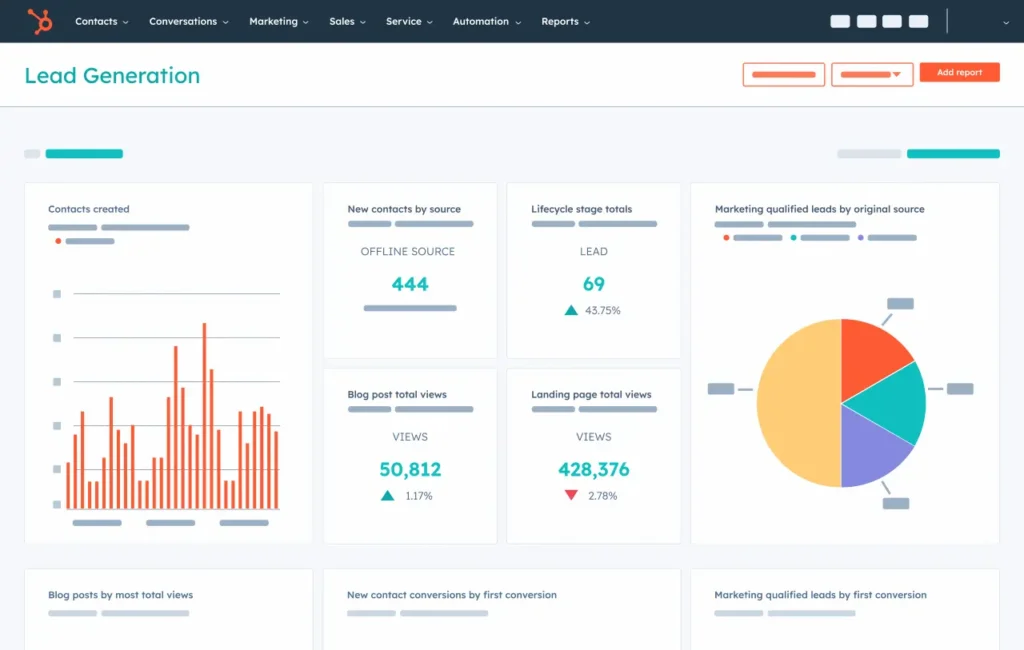
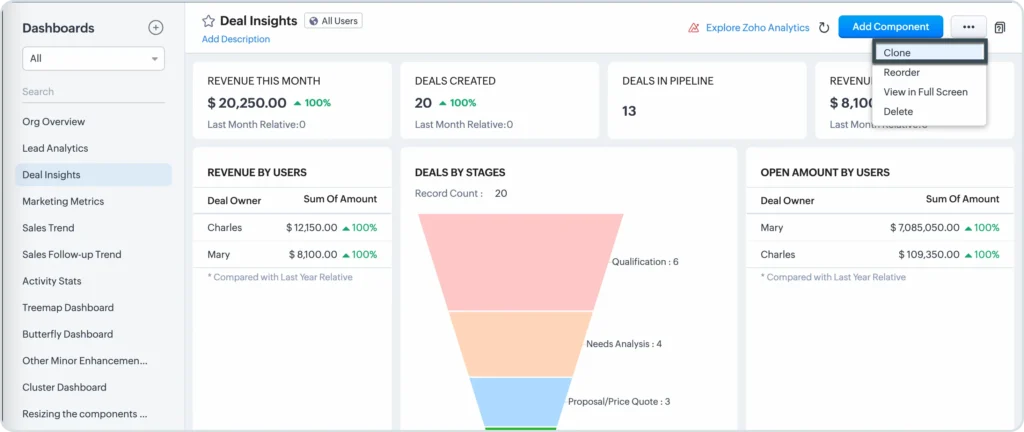
HubSpot vs Zoho: Feature-by-Feature Comparison
Eleven criteria covering the features that determine the HubSpot vs Zoho outcome for most sales and marketing teams in 2026.
| Feature | 🟠 HubSpot | 🔵 Zoho CRM | Winner |
|---|---|---|---|
| Free Plan | Unlimited users, strong feature set | Up to 3 users, basic features | HubSpot |
| Ease of Use | G2 score 8.7 — fastest onboarding | G2 score 8.3 — requires configuration | HubSpot |
| Marketing Automation | Native, unified with CRM | Requires Zoho Campaigns add-on | HubSpot |
| Customization | Limited — opinionated structure | Deep — custom modules, fields, buttons | Zoho |
| AI Features | Breeze AI (add-on $30/user) | Zia AI included from Enterprise plan | Zoho |
| Workflow Automation | Strong (Professional+) | More flexible, available from Standard | Zoho |
| Lead Scoring | Professional plan only | Available from Standard plan | Zoho |
| Reporting & Analytics | Clean dashboards, easier to read | More powerful but complex to configure | HubSpot |
| Developer Platform | Good API, app marketplace | Far more extensive developer tools | Zoho |
| Customer Support | G2 score 8.6 vs Zoho 7.4 | Inconsistent — varies by region | HubSpot |
| Price (5 users, pro tier) | ~$1,900/mo + $3,000 onboarding | ~$115/mo, no onboarding fee | Zoho |
Data as of March 2026. Verify current pricing on HubSpot.com and Zoho.com before committing.
HubSpot vs Zoho Pricing Breakdown
The HubSpot vs Zoho pricing gap is the most dramatic in any major CRM comparison. HubSpot’s free tier is genuinely strong — unlimited users, contact management, deal pipelines, and basic automation. The problem is the cliff between free and professional. HubSpot Sales Hub Professional jumps to $1,600/month base (3 users) with a mandatory $3,000 onboarding fee. That’s over $22,000 in year-one costs for a small team. Zoho Professional covers the same 5-person team for $1,380/year — no onboarding fee required.
Zoho’s pricing structure rewards scale. Every tier includes features that HubSpot locks behind higher plans: lead scoring starts at Zoho Standard ($20/user), workflow automation is available from Standard, and AI features (Zia) come included at Enterprise ($65/user) — not as a $30/user add-on. For budget-conscious teams, the HubSpot vs Zoho math tilts heavily toward Zoho past the startup stage.
Use Cases & Workflow Examples
Choosing between HubSpot vs Zoho is clearest when you look at specific team profiles. Building a solid sales workflow depends on picking the platform that matches how your team actually operates — not just the one with the better demo.
Marketing-Led SaaS Startup
A 15-person SaaS company where marketing drives inbound leads and sales works the pipeline. HubSpot’s unified Marketing Hub and Sales Hub mean leads captured via landing pages, email campaigns, and live chat flow directly into the CRM without manual handoffs or integration work. The team is up and running in days, not weeks. Zoho can replicate this setup but requires configuring Zoho Campaigns separately and building the lead flow manually. Winner: HubSpot.
Mid-Market Sales Team with Complex Processes
A 25-person B2B sales team with custom deal stages, territory assignment rules, product catalogs, and multi-step approval workflows. Zoho CRM’s custom modules, workflow engine, and developer platform handle this level of complexity natively — at Professional or Enterprise tier pricing. HubSpot can approximate this on its Enterprise plan but hits customization ceilings on custom modules (capped at 10) and custom object associations. At this complexity level, Zoho delivers more for significantly less. Winner: Zoho.
Small Business Starting Fresh
A 5-person team moving off spreadsheets, no technical resources, and a need to get organized this week. HubSpot’s free CRM is the fastest path to a working system — contact management, deal pipelines, email integration, and basic reporting are all available immediately with no configuration required. Zoho’s free plan covers 3 users and requires more setup to reach the same baseline. Winner: HubSpot Free.
Budget-Conscious Growing Business
A 20-person company that needs lead scoring, automation, custom reports, and forecasting but cannot justify $1,600/month for HubSpot Professional. Zoho Standard at $20/user/month covers lead scoring and workflow automation. Zoho Professional at $35/user/month adds inventory management and sales signals. Total cost for 20 users: $700/month vs HubSpot’s minimum of $1,600/month plus onboarding. Winner: Zoho — by a wide margin.
Pros & Cons
HubSpot CRM — Strengths & Limitations
- Best-in-class free CRM — unlimited users, no time limit
- Fastest onboarding — productive in hours, not weeks
- Native marketing automation unified with sales pipeline
- Clean, modern interface with minimal learning curve
- Strong customer support — G2 score 8.6/10
- $3,000 mandatory onboarding fee on Professional tier
- Professional starts at $1,600/month — steep for small teams
- Limited customization — 10 custom module cap on Enterprise
- AI features (Breeze) are a paid add-on at $30/user/month
- Lead scoring locked behind Professional plan
Zoho CRM — Strengths & Limitations
- Most affordable CRM at scale — Enterprise at $50/user/month
- Deep customization — custom modules, buttons, fields, logic
- Lead scoring from Standard plan ($20/user)
- Zia AI included at Enterprise — no add-on cost
- Extensive developer platform for custom integrations
- 2–4 weeks of setup to realize full platform value
- Marketing automation requires separate Zoho Campaigns license
- Support quality inconsistent — G2 score 7.4/10
- Interface less polished than HubSpot
- Free plan limited to 3 users only
Integration Ecosystem
Both platforms connect to the standard SaaS stack. HubSpot’s App Marketplace has 2,000+ integrations and is widely regarded as higher quality for marketing tools. Zoho’s marketplace has 800+ native integrations but compensates with a far more powerful developer API and its own internal ecosystem of 55+ Zoho products that integrate natively at no extra cost.
HubSpot vs Zoho: Which One Should You Use?
Three questions that resolve the HubSpot vs Zoho decision for most teams without needing a trial of both platforms.
Final Recommendation
Pick HubSpot if you’re an inbound-focused team that wants fast adoption, native marketing automation, and a clean interface that non-technical users can operate without training. HubSpot’s free CRM is one of the best starting points in the category — use it until you hit its limits, then evaluate whether the Professional jump is justified for your revenue stage. The HubSpot vs Zoho answer here is clear: HubSpot earns its price when marketing and sales are tightly integrated and the team lacks technical resources to configure a more complex system.
Pick Zoho if your team is past the startup stage, has some technical capacity, and needs features like lead scoring, advanced workflows, AI, and deep customization at a price that doesn’t require a board presentation. The HubSpot vs Zoho cost difference at the professional tier is not marginal — it’s $20,000+ in year-one costs for a 5-person team. Zoho’s setup investment pays back within the first quarter for any team that uses the platform consistently.
The hybrid approach worth considering: start on HubSpot Free to get organized quickly, validate your sales process, and identify exactly which features you actually use. Then make the HubSpot vs Zoho decision based on real usage data rather than feature checklists. Teams that do this almost always find that Zoho covers 90% of their actual needs at 15% of HubSpot Professional’s cost.